If you are a compliance officer or someone involved in an organization’s compliance process, you know the challenges that come with it. Most times, it’s not the audits themselves, but the months that go into preparing for them, which could include gathering evidence, chasing down members to fill forms, and verifying everything many times over. Despite all this hardwork, you still worry if you’ve missed something that could blow up at any time.
The good news is, Vanta was built exactly for this. It can reduce your workload and improve your organization’s compliance readiness, all at an affordable cost.
In this review, let’s do a deep dive to understand if this tool is actually worth it, including what it does well, what it doesn’t, and who it is built for.
But before answering these questions, let’s quickly understand the need for a compliance tool.
Do You Need a Compliance Tool?
Most companies don’t think of a compliance tool until forced to.
Let’s say, a big company is asking for your SOC 2 report before signing a contract. Your legal team also flags that you need to become GDPR-compliant before expanding operations to Europe. Similarly, a new market area you want to enter requires ISO 270001 certification.
At that point, you have two options. You can try to manage it manually through spreadsheets, shared drives, and even designate one person as the internal compliance expert by default. Or you can use a platform that does most of the heavy lifting for you, like monitoring your systems, collecting evidence automatically, telling you what you’re missing, and keeping everything audit-ready.
The case for a tool like Vanta isn’t just about saving time (though it does that). It’s also about accuracy. Compliance programs fail when evidence is incomplete, when teams self-report without verification, or when someone misunderstands what a framework actually requires. Automated, continuous monitoring removes a lot of that risk.
What is Vanta?
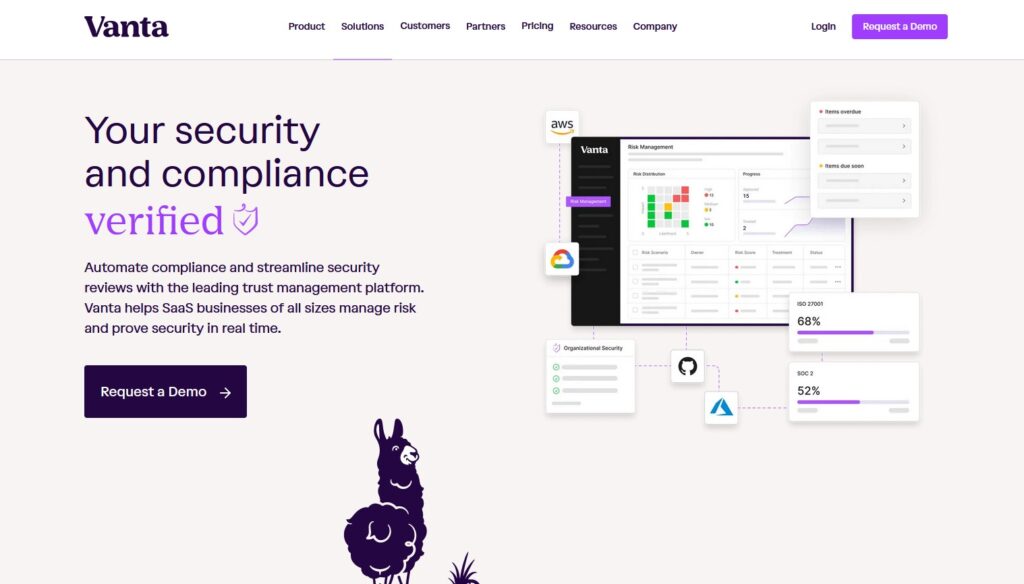
Vanta started out as a compliance automation platform for SOC2, and in the last few years, it has expanded into something much bigger. Today, it offers something called an Agentic Trust Platform, which is a single place to manage your compliance, risk, vendor security, audit prep, and even the customer-facing proof of your compliance.
With such features, more than 15,000 businesses use this tool.
Essentially, Vanta connects to your existing systems, including AWS, GitHub, Google Workspace, HR tools, identity providers, and 400+ more, and automatically pulls the evidence needed to demonstrate compliance with your chosen frameworks. Instead of asking someone to manually screenshot that access controls are in place, Vanta checks it for you, continuously, and flags issues the moment they appear.
Over the last year, Vanta has gone well beyond that foundation. It now has an AI agent that can handle evidence collection, draft security questionnaire responses, and suggest fixes for compliance gaps. It has a Risk Graph that shows how risks across your organization connect and spread. It has tools for managing vendor security, tracking customer commitments, and handling privacy compliance workflows like GDPR data processing records and impact assessments.
Vanta Overview (FREE TRIAL, DEMO)
With this review, we aim to provide an in-depth exploration of Vanta’s distinctive features, advantages, drawbacks, and target audience. Through this analysis, we aim to shed light on the unique value proposition that Vanta offers compared to other compliance management tools. Our goal is to equip organizations with the insights they need to make informed decisions about their compliance management needs.
Vanta assists compliance teams in streamlining policy implementation while fostering a culture of security and accountability within organizations. Its AI-driven processes, pre-populated templates, and daily monitoring alerts empower organizations to traverse complex regulatory terrains with ease, minimizing delays, costs, and hurdles along the way.
By offering a clear way of measuring progress toward and detecting barriers in the way of the goal of audit readiness, Vanta enables organizations to proactively manage risks and tackle compliance challenges head-on. To top it all off, Vanta offers demos and free trials to anyone with a company email – and who doesn’t love an opportunity to try before you buy?
Key Features of Vanta
Vanta has many useful features that can help teams across the compliance process. We have explained the most important ones to help you better understand how Vanta can fit into your compliance journey.
1. Vanta AI Agent 2.0
This is Vanta’s flagship feature.
The AI Agent works in the background to collect and validate audit evidence. It also reads the filled-in security questionnaires sent by customers or partners and proactively recommends fixes when it finds compliance issues.
The practical impact of this feature is significant. Vanta reports that customers using the agent see 129% greater team productivity, 42% less risk exposure, and 81% faster security reviews. That last number matters especially if your sales team is used to deals slowing down while prospects wait for security questionnaire responses.
It’s worth noting that the most powerful AI Agent features are available on higher-tier plans, not the entry-level package.
2. Risk Graph
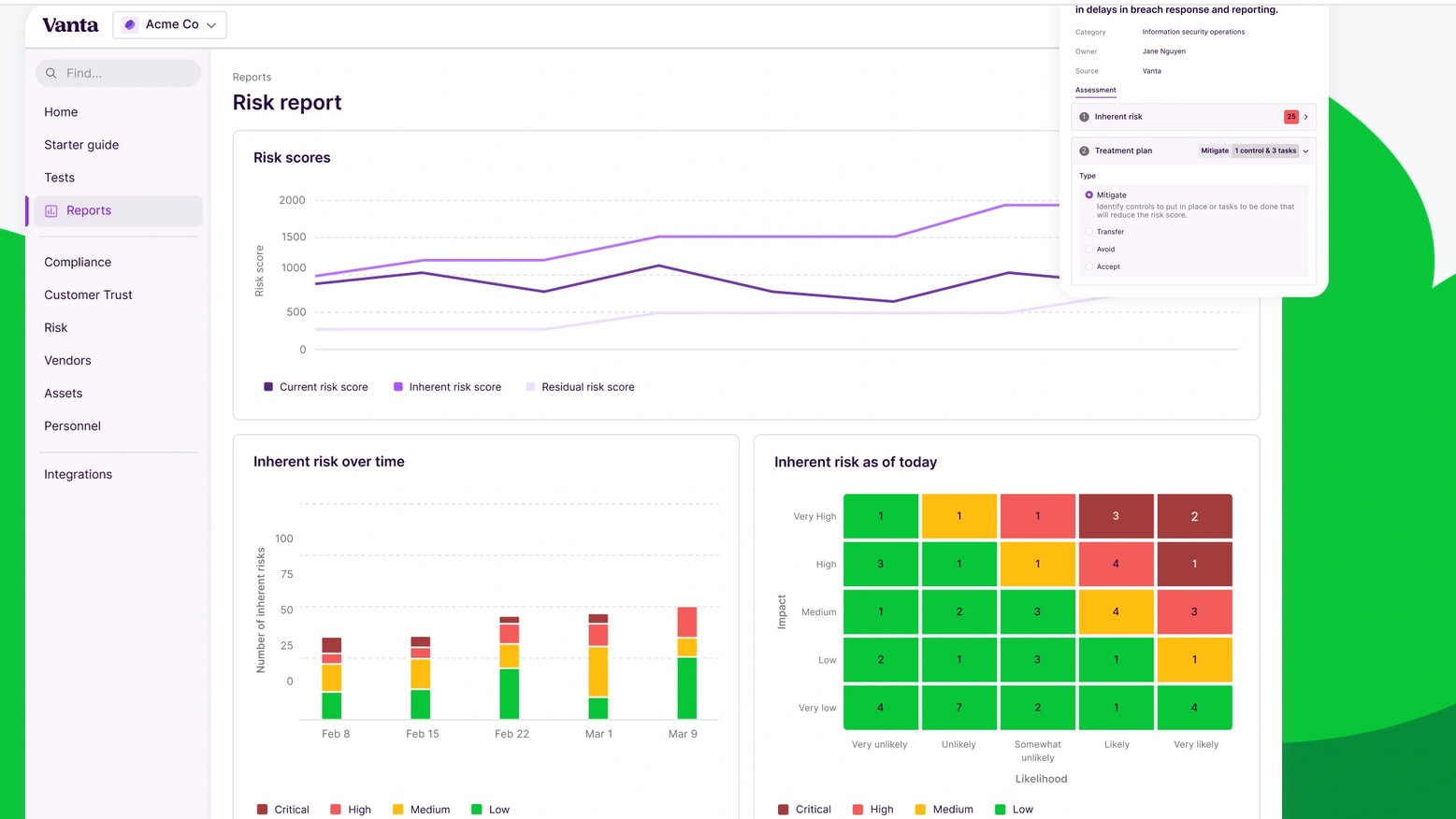
Another key tool is the risk graph. It maps how risks in your environment connect to each other, so if one issue in your cloud infrastructure is related to a gap in your vendor controls, you can see that relationship rather than treating them as isolated problems.
Think of it like a map of your risk exposure rather than a to-do list. For security leaders managing complex environments, this is genuinely useful as it shows you where to focus, which risks have the most impact, and how threats could spread if left unaddressed.
3. Multiple Risk Registers
Previously, Vanta’s risk management was a single unified register. Now you can organize risk by business unit, product line, geography, or any other structure that makes sense for your organization. Each team can get a tailored view of the risks relevant to them, without having to wade through everything else. For companies with distributed teams or multiple products, this makes a meaningful difference.
4. Organizations Center
If you’re managing compliance across multiple subsidiaries, product lines, or geographies, this is where Vanta starts to earn its enterprise credentials. The Organizations Center lets you connect multiple Vanta workspaces into a single view, so leadership can see the overall compliance posture while each team still manages its own program. It’s the difference between emailing five regional compliance teams for status updates and just opening a dashboard.
5. Customer Commitments
This one is a bit niche but genuinely solves a real problem. When you sign enterprise contracts, you often make specific security promises: “We’ll notify you within 72 hours of a breach,” or “We’ll alert you before adding new subprocessors.” These commitments get buried in contracts and are easy to lose track of, especially when an actual incident occurs, and you’re scrambling to remember who you made which promises to.
Customer Commitments centralizes all of those obligations, maps them to the relevant controls in Vanta, and automates alerts when a commitment is at risk of being missed. It also pushes updates to customers through the Trust Center so they can see that promises are being kept. For companies with a large enterprise customer base, this removes a real compliance and relationship risk.
6. Privacy Automation
Launched in March 2026, this feature brings GDPR and privacy compliance properly into the Vanta ecosystem. You can now manage your Records of Processing Activities (ROPAs), run Data Protection Impact Assessments (DPIAs), and maintain a data inventory – all within the same platform. The benefit is a unified view, as your privacy obligations and your security posture are in the same system, which makes it easier to spot where gaps in one area affect the other.
7. Continuous Monitoring and Audit Readiness
This feature remains one of Vanta’s core strengths. It continuously monitors your connected systems and keeps evidence up to date automatically.
New additions like Intelligent Request Lists (IRLs) let you import an auditor’s request list directly into Vanta, assign owners to each item, and track progress in one place. Similarly, Controlled Audit Views let you give auditors access to exactly what they need without exposing the rest of your platform.
8. Vendor Risk Management
Your security is only as strong as the weakest vendor you rely on. Vanta’s vendor risk management lets you onboard vendors, send security reviews, and continuously monitor their compliance posture. Vendor AI Answers uses the AI Agent to automatically respond to vendor questionnaires based on verified data, which speeds up the back-and-forth.
Likewise, automated offboarding (launched in early 2026) ensures vendor access is properly revoked when a relationship ends, closing a gap that often gets missed in manual processes.
9. Questionnaire Automation
If your company is growing, you’re probably getting more security questionnaires from potential customers than you can comfortably handle. Each one can take hours to complete manually, and they often ask the same questions in slightly different formats. Vanta’s questionnaire automation uses your verified compliance data to draft responses automatically, flags anything it can’t answer confidently, and delivers something your team can review and send rather than build from scratch.
10. Framework Coverage
Vanta covers a broad range of compliance frameworks: SOC 2, ISO 27001, ISO 42001, HIPAA, HITRUST, GDPR, FedRAMP, NIST CSF, NIST AI Risk Management Framework, PCI DSS, CCPA, and custom frameworks. Importantly, when you’re working toward multiple certifications, Vanta maps overlapping controls so you’re not duplicating effort. For example, a control that satisfies SOC 2 and ISO 27001 gets credited to both, automatically.
11. Trust Center
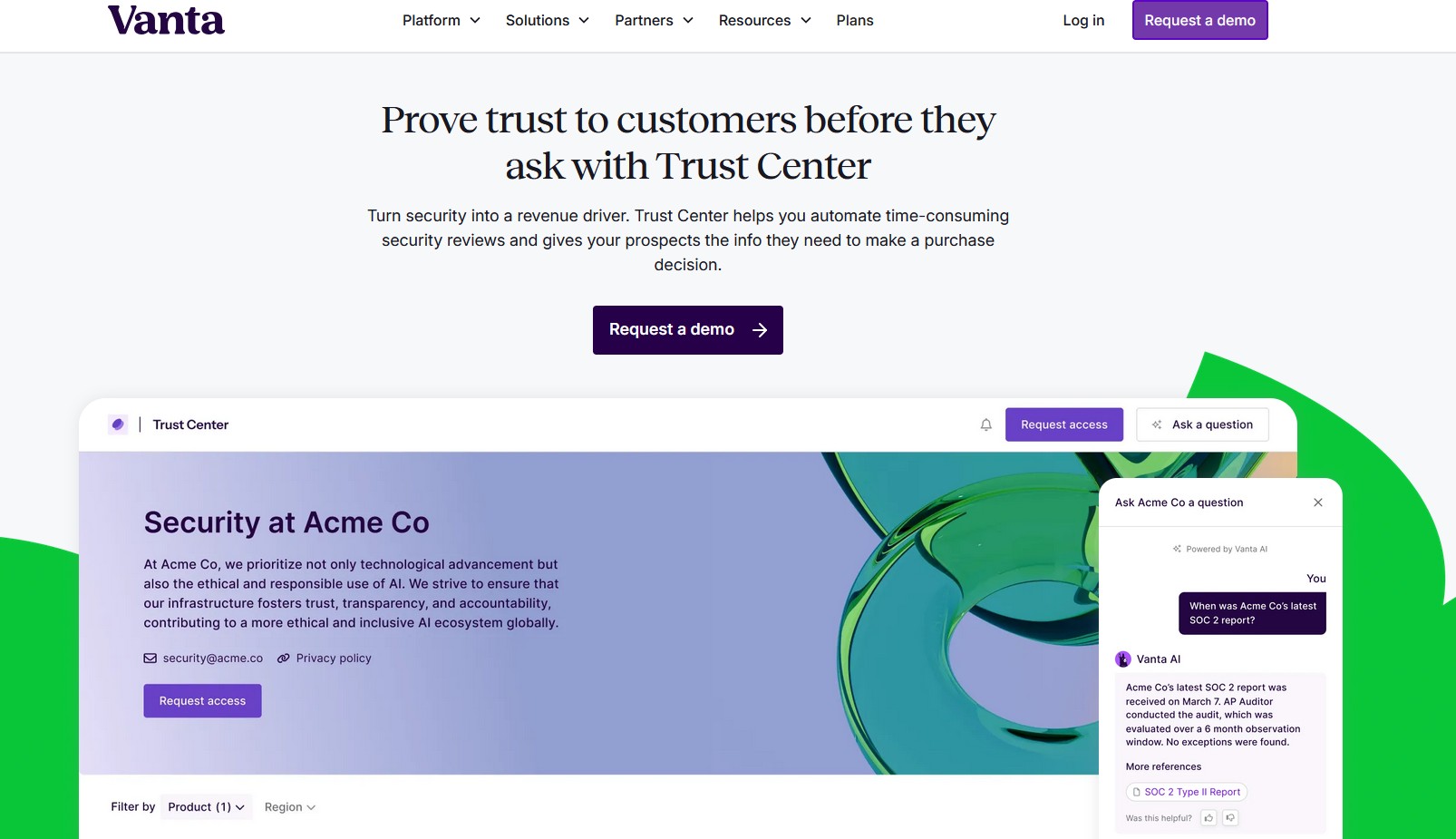
Instead of responding to security questionnaires one at a time, you can direct prospects and customers to your Trust Center – a public-facing page that shows your current compliance status, certifications, and security documentation in real time. It’s a small thing that makes a difference in enterprise sales, as prospects can quickly check your Trust Center and move forward. Customer Commitments integrates directly here too, so customers can see the specific promises you’ve made to them are being tracked and honored.
Now that you have an idea of the features, let’s move to the pros and cons, so you can make an informed decision.
Pros:
- Useful AI: The AI Agent 2.0 collects evidence, drafts questionnaire responses, and suggests fixes for better efficiency.
- Unified Platform: Vanta brings together compliance automation, risk management, vendor security, and customer-facing documentation to reduce tool sprawl.
- Overlapping Frameworks: When you’re pursuing multiple certifications, Vanta maps overlapping controls automatically to save time and effort.
- Audit-ready: Continuously monitors your systems and collects and validates evidence to keep your system audit-ready at all times.
- Privacy: ROPA management and DPIAs boost privacy and ensure GDPR compliance.
- Vendor Monitoring: Continuous vendor monitoring, automated questionnaire responses, and automated offboarding close gaps in vendor management programs.
- Trust Center: Being able to point enterprise prospects to a real-time view of your compliance status improves trust in your operations.
Cons:
- Higher Tiers: The full AI Agent, Risk Graph, and advanced risk management capabilities require a higher-tier plan.
- Overwhelming: Vanta has grown significantly in scope. For a small team that just needs to get SOC 2 done, the breadth of features can feel overwhelming at first, especially without a dedicated compliance person to manage the platform.
Who Is Vanta Best For?
Vanta works well for companies of all sizes, but here’s where it makes the most sense.
Startups
Startups often find it overwhelming to get SOC 2 or ISO 27001 to close enterprise deals. This is where Vanta’s automated evidence collection, pre-built templates, and guided workflows come in handy. The Trust Center also adds credibility.
Mid-size Companies
A good choice for companies that are working through multiple frameworks. Vanta’s overlapping control mapping and multi-framework support can reduce workload and improve compliance speed.
Enterprise Security Teams
The Organizations Center, Risk Graph, and advanced risk registers are built for companies with distributed teams, multiple products, and complex risk landscapes. It provides a consolidated view of compliance and risk across business units.
Healthcare and Fintech Companies
HIPAA, HITRUST, and financial regulatory frameworks are well-supported, and the new privacy automation capabilities make GDPR compliance much less of a separate effort.
Sales-led Organizations
Vanta helps sales teams close deals quickly with its features, like questionnaire automation and Trust Center.
Bottom Line
Vanta started as a SOC 2 tool and has grown into one of the most complete compliance and trust management platforms on the market. The AI Agent 2.0, Risk Graph, Customer Commitments, and Privacy Automation ease the compliance process.
At the same time, it’s important to note that the best features require higher-tier plans, and smaller teams without compliance experience may need time to get up to speed. But for companies that are serious about compliance, whether you’re getting your first SOC 2 or managing a complex multi-framework program across a distributed organization, Vanta is one of the strongest options available right now.
Our recommendation: if you’re evaluating compliance tools and you have budget for a proper platform (not just a checklist), put Vanta at the top of your shortlist. Get a demo, see the AI Agent in action, and compare it against other tools.