
GDPR has been live since 2018, and eight years on, it has become an integral part of operations for companies that have a presence or cater to customers in the European Union. Also, regulators are enforcing GDPR in full force, as is evident from the growing fines. In 2025 alone, the fines amounted to about 1.2 billion Euros.
Many companies see GDPR compliance as a burden and something that must check the tick boxes. While this is true to some extent, you can turn GDPR into a strategic advantage and infrastructure investment when done correctly.
GDPR: Data Protection re-invented
GDPR was built on a straightforward idea – personal data must belong to the individual it’s about.
Though this might sound straightforward, the advent of the digital economy came with rampant data collection and targeted advertising, all without the explicit consent of the user. This led to the emergence of GDPR in the first place.
At its core, GDPR is all about accountability. A company that is collecting data about a person must explicitly state how the data will be used, where it will be stored, and how it will be shared. Only if the user consents to the company’s data handling practices can the company collect data. Also, you should give users the option to remove their data at any time. Above everything, the onus of proving that the company has followed all these regulations lies with the company itself!
If you are a business, there are two aspects to keep in mind.
GDPR applies to your organization if you process the personal data of EU residents, regardless of where you are based. Secondly, personal data is defined broadly and includes anything that can help identify a specific individual. This definition of personal data also includes AI-generated inferences.
The Core Principles
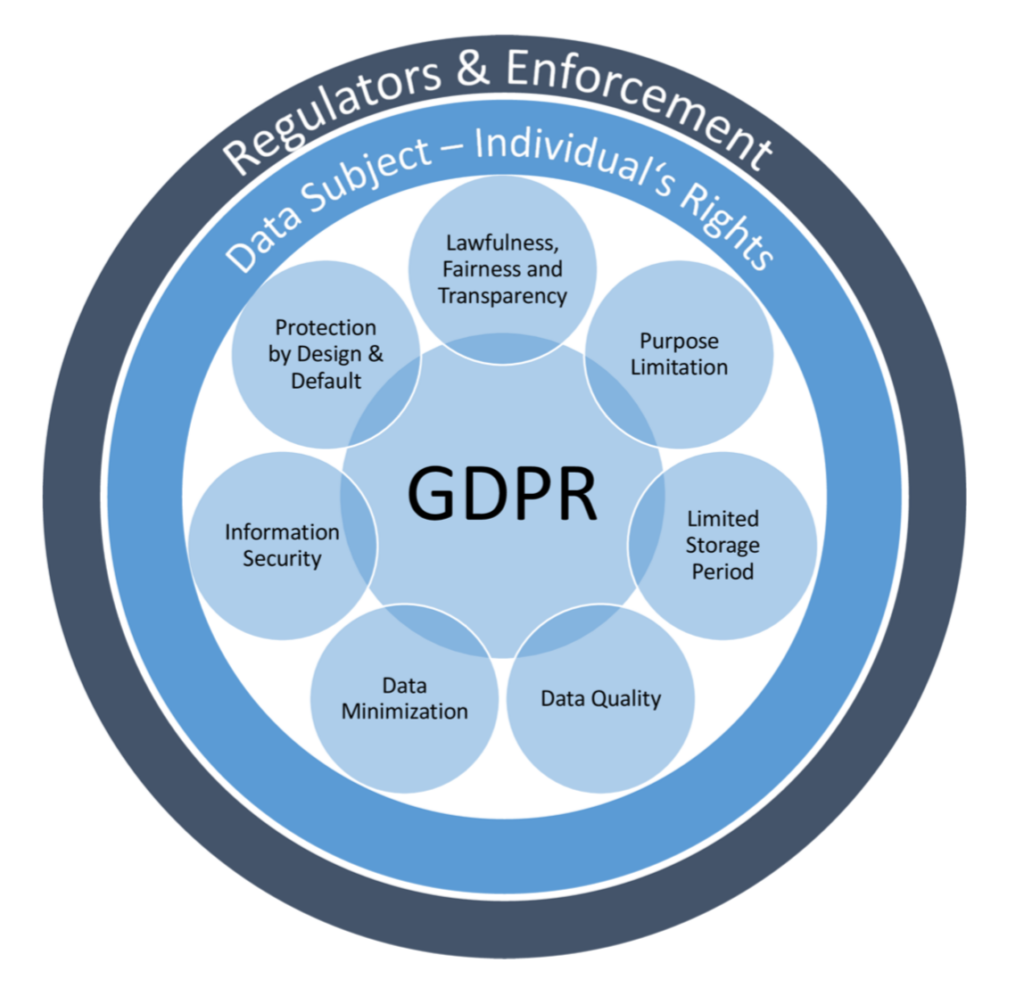
GDPR is built around ten guiding principles, and every data processing decision and activity must adhere to these principles.
- Lawfulness, Fairness and Transparency
- Purpose limitation
- Limited storage periods
- Data quality
- Data minimization
- Accountability
- Information security
- Data protection by design and by default
- Legal basis for processing
- Requirements for onward transfer
In practice, these principles translate to the need for a clear, accurate map of your entire data landscape. Where does personal data come from? Where is it stored? Who touches it, and when? That level of visibility is not easy to get and requires structured and automated systems, documented processes, regular audits, and ongoing maintenance.
In 2026, the EDPB’s coordinated enforcement focus is on Articles 12–14, namely, the transparency and information obligations. Regulators are actively checking whether organizations are clearly and accurately telling people how their data is being used. If that’s something your organisation has deprioritized, it’s worth revisiting now.
Step Up in Enforcement
One of the most significant shifts GDPR brought was a step change in enforcement. Before 2018, data protection fines across Europe were modest and relatively rare. Fast forward to 2026, and so far, we have seen fines exceed seven billion Euros within the first few months. Though these fines have been accumulating since 2023, these numbers are clear signs that regulators are taking data privacy as the top priority for 2026.
Some of the biggest fines have been given to tech companies, like Meta, Amazon, and TikTok. Also, companies in finance, healthcare, telecoms, and public sector organizations are all seeing increased scrutiny. The enforcement map is widening, not narrowing.
One point worth emphasizing is that GDPR does recognize effort. Regulators can reduce fines where an organization demonstrates that its approach to data protection was proactive, had good intent, comprehensive, and well-documented. But that doesn’t take the responsibility off the organization. If a claim is filed, it is on the organization to demonstrate compliance, not on the regulator to prove a breach.
AI: The New Complication
2026 is seeing a new twist to GDPR, and that’s AI. Since many of the AI companies are not transparent about the data on which their models were trained, it’s becoming harder to prove compliance.
Moreover, the EU AI Act is approaching full applicability, with the August 2026 deadline for high-risk AI systems now very close. And GDPR and the AI Act overlap significantly.
If you’re deploying AI tools that process personal data from HR systems to customer analytics to fraud detection, you likely have obligations under both frameworks simultaneously. The European Data Protection Board has made clear that large language models and similar systems rarely meet the anonymization standards required to step outside GDPR’s scope. Using a third-party AI model that ingests personal data makes you a data controller for those purposes.
This isn’t a reason to avoid AI. But it is a reason to make sure your data governance infrastructure is solid before you scale up AI deployment. The organizations that get this right are the ones who built GDPR compliance properly the first time, and now have the visibility and controls to extend that framework to new use cases.
Now, GDPR is not all doom and gloom. It also presents a huge opportunity with the right strategy.
Why is GDPR a Strategy?
GDPR is undoubtedly demanding, but if you treat it purely as a compliance cost, you’re missing something important.
Think about what genuine GDPR compliance actually requires. You need to know exactly what data you hold and where it lives. You need clear records of why you process it and who has access. You need to respond quickly to data subject requests, including access, deletion, and correction. You need to detect and report breaches within 72 hours.
That level of data governance doesn’t just satisfy regulators. It makes your business better. When you have a clear, accurate picture of your data landscape, you can make better decisions, respond faster to customers, and reduce the drag of fragmented or duplicated data. According to the 2026 Thales Data Threat Report, only 34% of organizations currently have complete knowledge of where their data is stored. That gap is both a compliance risk and an operational inefficiency.
There’s also a trust angle. Consumers are more attuned to data privacy than they were five years ago. Demonstrating that you handle personal data responsibly is a genuine competitive differentiator. Customers and partners choose organizations they trust. Regulators treat repeat offenders far more severely than first-time violators.
All this means that with the right approach, strategy, systems, and processes, you can have complete visibility into your data handling methods, prove compliance, and build trust in the minds of customers and partners.
Role of RegTech
Manually managing GDPR compliance at scale is extremely difficult. The volume of data most organizations hold today, the number of systems it flows through, and the pace at which regulations evolve make spreadsheet-based approaches unreliable at best and dangerous at worst.
That’s where RegTech earns its place. The best GDPR-focused solutions go beyond automation to create an auditable map of your data environment. The goal is to connect data to the procedures, systems, and regulations that govern it, in a way that’s transparent and easy to interrogate when a regulator or internal audit team comes asking.
A well-implemented RegTech solution should give you:
- Clear, verifiable evidence of your compliance posture that you can actually show a regulator.
- Real-time visibility into where personal data sits across your systems.
- The ability to respond to data subject requests quickly and accurately.
- Automated alerts and audit trails for breach detection and 72-hour reporting.
- A framework that extends naturally to AI governance obligations under the EU AI Act.
- Insights that help you understand and manage your data more broadly.
That last point matters more than ever in 2026. The same infrastructure you build for GDPR doesn’t sit idle between regulatory reviews. It supports data quality, feeds analytics, and gives you the foundations to meet whatever comes next – whether that’s tighter AI Act obligations, new cross-border transfer requirements, or sector-specific rules.
Bottom Line
Eight years in, GDPR enforcement is accelerating, and the regulatory landscape is getting more complex. Organizations that are thriving are the ones that used the regulation as a forcing function to get their data house in order.
That said, implementation is not easy because GDPR involves extensive data mapping, ongoing compliance management, strict accountability, growing AI-related obligations, and serious financial exposure if things go wrong. But the opportunity is equally real. Done properly, GDPR compliance builds the kind of data governance infrastructure that makes an organization more transparent, resilient, and operationally effective.
RegTech helps make this compliance more manageable. Learn more about how our partners help with GDPR compliance.